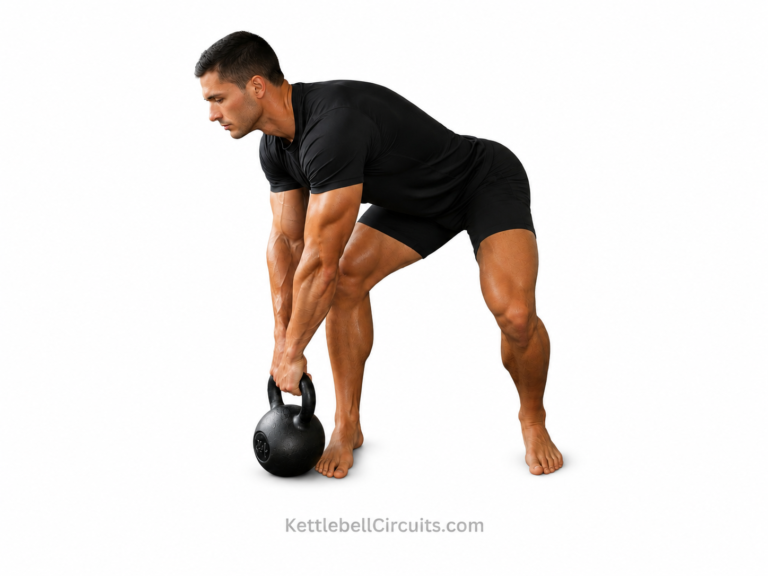
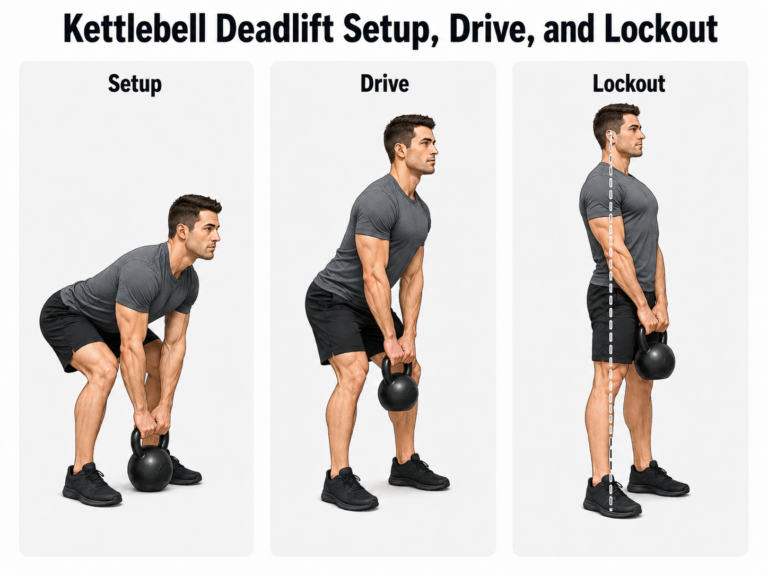
You have put in the training. Your working weights have gone up, your swings feel solid, and by any reasonable measure, you are stronger than you were six months ago. But you are not noticeably faster. The jump isn’t higher, the sprint isn’t quicker, the bell doesn’t snap overhead the way it seems to for people who move explosively. Or maybe you’re on the other side of the same problem: you swing the bell fast, breathe hard, and assume that because the movement looks explosive, you’re training power.
Left alone, neither version resolves itself. Strength contributes to power, but past the beginner stage, the transfer becomes less reliable on its own — force you cannot express quickly stays in the tank when speed matters. And explosive movements done to exhaustion quietly stop being power work at all: the reps slow down, and slow reps no longer serve the quality you’re trying to build.
The fix is to treat power as its own trainable quality, with its own parameters. Kettlebell power training is done fast and fresh — low reps, full rest, and a hard stop the moment speed drops. The rest of this article covers what power actually is, why the kettlebell suits it, which exercises qualify, the numbers that govern the work, and the skill that holds it all together: knowing when a set is over.
Power Is Strength Delivered Quickly
In mechanical terms, power is force multiplied by velocity — how much force you can produce, and how fast you can produce it. Strength is the ceiling of force you can generate; power is how quickly you can express a portion of that ceiling. Two lifters with the same one-rep max can differ enormously in how fast they can move a lighter bell, and it’s the faster expression that shows up in a jump, a sprint, or a punch.
If you’re new to training, general strength work alone will raise your power output — a rising ceiling lifts everything under it. But as training status rises, that free transfer diminishes, and expressing force quickly becomes something you have to train at velocity, deliberately.
A six-week trial makes the distinction concrete. Otto and colleagues (2012) had thirty healthy young men train twice a week with either heavy weightlifting or kettlebells. The weightlifting group built significantly more maximal strength — heavier loads do that. But vertical jump — one of the study’s power measures, alongside power clean 1RM — showed no between-group difference. Strength and power responded to different features of the training in the population studied. That is the gap this article is about: you can raise the force ceiling without fully training fast access to it.
Why Kettlebells Suit Power Training
The kettlebell’s shape does real work here. The handle sits above an offset mass, which suits ballistic, hip-driven movement: the bell can be accelerated hard, allowed to float, and caught, in a way that plates on a bar don’t invite. The swing arc lets a submaximal load reach high velocity — the speed, not the weight, provides the training stimulus. And kettlebell ballistics are commonly regarded in the field as easier to introduce than the full barbell Olympic lifts, which makes genuine high-velocity training accessible sooner — though they carry their own technique demands.
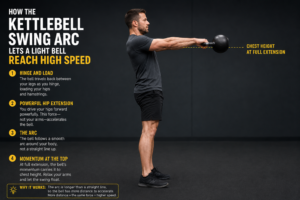
The research on this is specific. In healthy young men who could perform a proficient half squat, six weeks of twice-weekly kettlebell swing training improved maximum and explosive strength similarly to jump-squat power training performed at loads from 0–60% of one-rep max (Lake & Lauder 2012). Half-squat strength rose 9.8% and vertical jump 19.8% across the study, with no significant difference between the two training methods — and the kettlebell group achieved it with 12 kg and 16 kg bells in twelve-minute sessions. Within that population, a light bell swung hard held its own against a dedicated power protocol.
Five Kettlebell Exercises That Build Power
The selection criterion is rapid force production with control. Five movements meet it.
The swing — two-handed or single-arm — trains explosive hip extension, the engine behind jumping and sprinting.
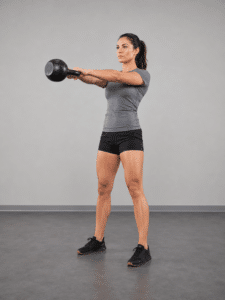
The clean trains you to redirect a moving load into the rack position, what some coaches call “steering strength.”
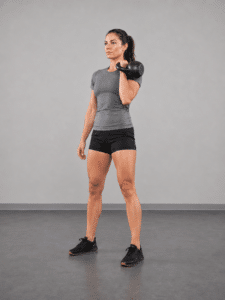
The snatch trains full-body coordination at speed, driving the bell from hip to overhead in one motion.
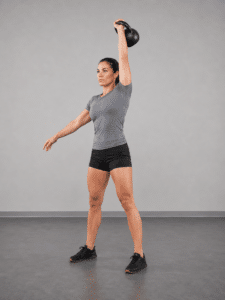
The push press trains leg-driven upper-body power — the dip and drive that sends the bell up before the arm finishes the job.
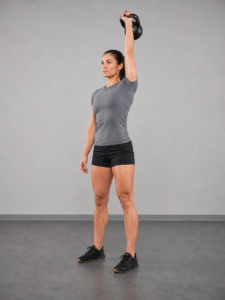
The high pull trains an aggressive hip-and-elbow pull without the overhead catch.
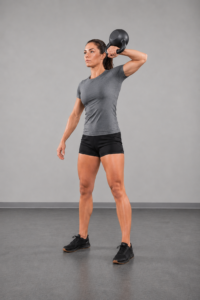
A skill note before you choose: the snatch and high pull are more technical than the swing. Earn the swing and the clean first; add ballistic overhead work once those patterns are solid. Full execution detail for each movement lives in its own exercise guide — what matters here is that these five qualify, and grinding lifts do not.
Sets, Reps, and Rest for Kettlebell Power Training
One principle governs every number in this section: rest long enough, and keep sets short enough, that every rep stays fast. The moment a parameter forces slow reps, it is no longer serving power.
The typical starting ranges follow from that principle. Keep sets low-rep — roughly one to five for heavier power work, up to about ten for lighter ballistics like swings, where the bell is light enough that speed survives the extra reps. Let rest scale with intent: 60–90 seconds holds up in power-focused circuits, while true maximal-velocity sets earn two to five minutes, because the goal of the rest is full recovery, not elevated heart rate. Increase speed before you increase load — a heavier bell moved slowly is a step backward. And keep dedicated kettlebell power training to two or three sessions a week, spaced to allow full recovery between them.
The contrast with conditioning makes the mode visible. Conditioning wants shorter rest, higher reps, and accumulated fatigue — it trains your capacity to keep working. Power wants the opposite on every axis. If your rest is short, your reps are high, and your fatigue is climbing, you are conditioning, whatever the movement looks like.
When Should a Power Set End?
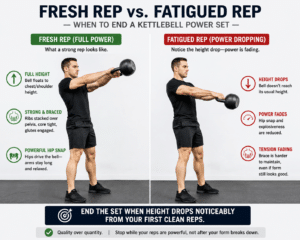
Before it has to. The set ends when bell speed visibly drops — not when the muscles burn, and well before failure. A core principle of velocity-based training is that grinding out slower reps under fatigue practices slower movement, which is the opposite of what the set exists to build.
The cues are observable without any equipment. The bell stops reaching its usual height. The hip snap loses its crack. The rhythm between reps stretches out. The catch gets noisy. The rep starts to feel grindy instead of crisp. Any one of these is the end of the set — rack the bell and rest.
One honest limitation, worth knowing: a sport scientist working in velocity-based training notes that a decline of around ten percent in movement speed is very hard to notice by eye. You will not catch the early slide. That is an argument for ending sets conservatively — stopping a rep or two before you think you need to — rather than pushing until the slowdown is obvious, by which point you have already trained several slow reps.
Where Power Fits in Your Training Week
Power work goes first. Within a session, do it early — after the warmup, before strength grinding or conditioning — because it depends on being fresh, and everything else in the session erodes freshness. Across the week, two or three dedicated exposures with rest days between them is the standard shape.
Power coexists with the rest of your training rather than replacing it. A strength day builds the force ceiling; a kettlebell power training day trains fast access to it; a conditioning day builds the capacity to repeat efforts. The order of operations inside any mixed session stays the same: fast work first, heavy work second, tired work last. Structured multi-week plans that arrange these days are their own topic — what matters here is the placement rule.
When to Build Strength and Technique First
Explosive training magnifies technical errors. A flaw that stays quiet in a slow goblet squat becomes a real problem at speed, and the swing pattern in particular places substantial load on the lower back when performed incorrectly — one of the highest-consequence mistakes for readers training kettlebell ballistics. The pattern comes first: your hinge, your clean, and your squat should be solid and repeatable before speed is added to any of them.
Hold off on power work — or modify it under qualified guidance — if any of the following applies: acute pain, a recent injury, symptoms that are not under control, joint issues, a history of shoulder, back, or knee injury, mobility restrictions that compromise the hinge or the overhead position, or a hinge and overhead pattern you have not yet learned to control. None of these is a diagnosis; they are reasons to establish basic strength and movement control first, and to get assessment from a qualified coach or clinician where symptoms are present.
The progression is unglamorous and reliable: technique, then speed, then load.
Quick Reference: The Power Session Rules
- Exercises: swing, clean, snatch, push press, high pull — earn the swing and clean before ballistic overhead work
- Reps: ~1–5 heavier power work; up to ~10 for light ballistics
- Rest: 60–90s in circuits; 2–5 min for maximal-velocity sets
- Frequency: 2–3 sessions weekly, rest days between
- Order: power first in the session, while fresh
- Progression: technique → speed → load
- Stop signal: bell height drops, hip snap slows, rhythm stretches, catch gets noisy, reps feel grindy — end the set early, before the slowdown is obvious