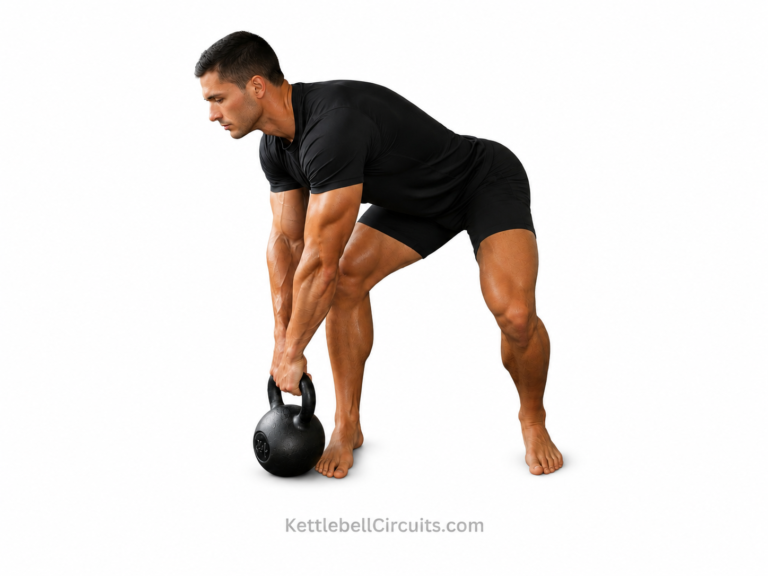
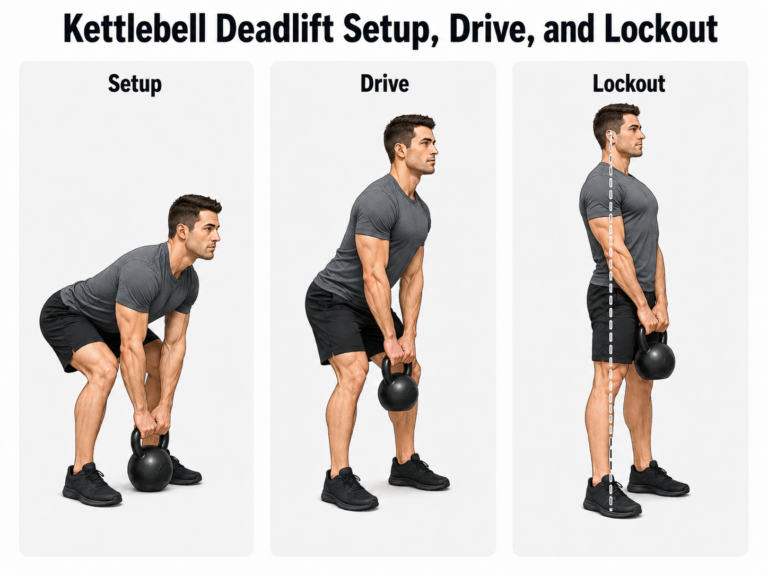
The final category in the progression — where the hips, feet, and trunk produce rotation at speed, built on the stability and motor control the first two categories developed.
Anti-rotation built the trunk stiffness to resist unwanted twist. Controlled rotation built the thoracic mobility and motor control to produce rotation through the right joints in the right sequence. Explosive rotation is where that preparation meets speed.
Every exercise in this article produces or manages rotation at speed through the hips, feet, and trunk. The hip snap that powers a standard kettlebell swing now includes a transverse component — the hips rotate as they extend, the feet pivot when the movement requires it, and the bell travels laterally, diagonally, or through a hand-to-hand path rather than straight ahead.
These are more demanding than basic kettlebell patterns. They require adequate thoracic mobility, sufficient hip internal and external rotation range of motion, and the trunk stiffness developed in the anti-rotation category. They should not be performed under fatigue or before the reader can control end range — the point where the bell’s momentum reverses and the core must decelerate the load without losing spinal position.
Readers with a history of spinal injury, disc herniation, chronic low back pain, shoulder instability, or pain with ballistic kettlebell work should consult a qualified professional before beginning explosive rotational training.
Prerequisites Before You Add Speed
Explosive rotation is not a starting point. Before adding speed to rotational training, the reader should be able to meet these benchmarks from the earlier categories.
From anti-rotation: the cross-body carry can be completed with a moderate bell while the trunk stays square for the full distance. The plank drag and renegade row can be performed without the hips twisting or shifting.
From controlled rotation, the windmill can be performed through a comfortable, controlled range with correct spinal mechanics. The wood chop descent is controlled — the bell does not fall through the eccentric phase. The lunge with rotation stays balanced without knee collapse, hip shift, or lumbar rounding.
If these benchmarks are not yet met, the reader benefits more from spending additional time in the first two categories than from adding explosive work on an unstable foundation.
One additional prerequisite deserves its own mention: do not train explosive rotation under fatigue. Rotational cleans, rotational presses, side swings, and figure 8s demand speed, timing, and control — qualities that degrade as fatigue accumulates. Program them early in the session, after the warm-up and before heavy strength work, when the nervous system is fresh and the core can still control the forces the hips produce.
The 4 Drills
The exercises below are sequenced from the easiest to identify and control to the most complex. The goal is not to invent exotic variations. The goal is to use kettlebell movements that are searchable, recognizable, and useful for training rotation at speed.
1. Kettlebell Side Swing
🖼️ IMAGE PLACEHOLDER: Kettlebell Side Swing
Hold the kettlebell with both hands and swing it laterally from one hip to the other. The weight shifts from leg to leg as the hips drive the bell side to side. The path of the bell stays in front of the body.
Cue: The hips drive the bell — the arms are the connection, not the engine. Shift the weight from one leg to the other with each swing. The torso rotates with the hips as a unit.
Common error: Keeping the weight centered over both feet and swinging with the arms. Without the weight shift and hip drive, the exercise becomes an arm swing with little rotational training effect.
What it trains: Lateral power transfer, oblique conditioning, and hip-to-hip force transfer under a ballistic load. The side swing is the cleanest entry point in this category because the bell path is easy to see: side to side, across the front of the body.
2. Rotational Kettlebell Clean
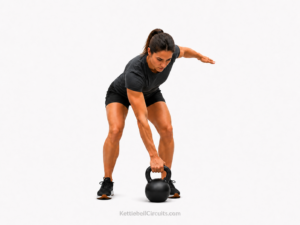
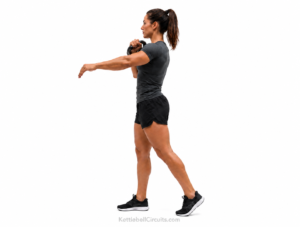
Suggested alt text: Athlete performing a rotational kettlebell clean with hip rotation driving the bell into the rack position.
Perform a single-arm clean with hip rotation driving the pull. As the hips snap forward, they rotate, and the bell travels into the rack position through a rotational arc rather than a purely vertical path.
Cue: The hip rotation drives the bell into the rack. Time the elbow drop with the hip rotation — the catch and the rotation should finish together.
Common error: Cleaning the bell vertically and then rotating after the catch. That splits the movement into two parts and removes the transverse component. The rotation and the clean should be one coordinated action.
What it trains: Rotational hip drive combined with catch control. The rotational clean teaches the body to generate and absorb rotational force at the speed of a clean, while still requiring the trunk to stay braced and organized.
3. Kettlebell Rotational Press
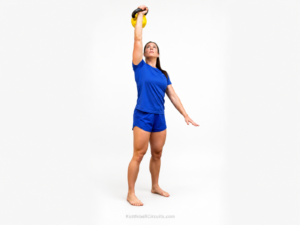
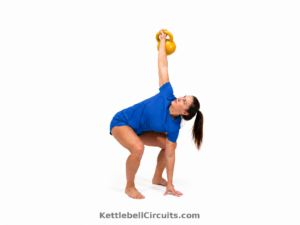
With the kettlebell in the rack, pivot the foot and rotate the hips as you press the bell overhead. The lower body helps drive the press through a coordinated rotational force transfer.
Cue: The press starts at the foot. Pivot, rotate the hips, brace the trunk, and let the force travel into the pressing arm. The bell should feel as if the lower body helped move it, not as if the shoulder pressed it alone.
Common error: Pressing with the arm while the hips stay square, or pivoting the foot without connecting that rotation to the press. The foot, hip, trunk, and arm have to work as one chain.
What it trains: Rotational force transfer into an upper-body press. This pattern resembles the way force moves in striking and throwing: from the ground, through the hips, through the trunk, and into the arm.
4. Kettlebell Figure 8
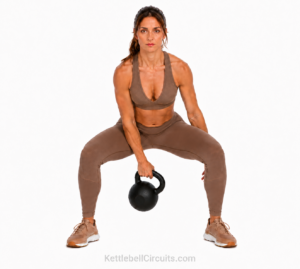
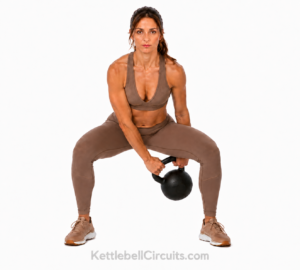
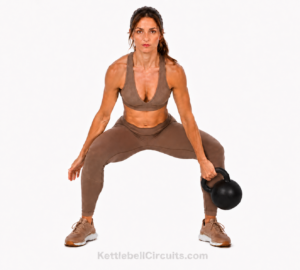
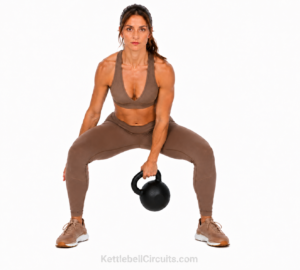
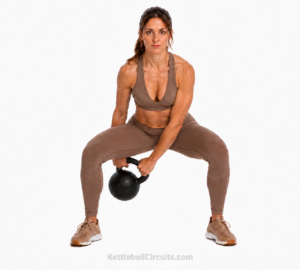
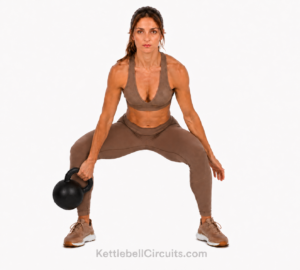
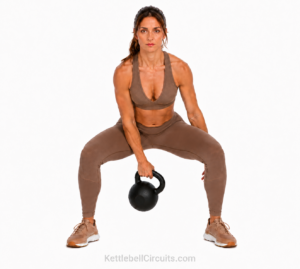
Pass the kettlebell in a figure-eight path around and between the legs, transferring it hand to hand while maintaining a strong hinge and controlled torso position. The bell travels around one leg, passes through the center, then moves around the opposite leg.
Cue: Stay hinged, keep the spine neutral, and let the hands pass the bell smoothly around the legs. The movement should be quick and coordinated, but not rushed or sloppy.
Common error: Standing too upright, rounding the back, or chasing the bell with the shoulders. The hips should stay loaded, the trunk should stay braced, and the bell should move around the legs without pulling the spine out of position.
What it trains: Fast hand-to-hand coordination, trunk control, hip hinge endurance, and transverse-plane control. The figure 8 is not a pure power drill like a swing or clean, but it belongs in this category because the bell moves dynamically through a rotational path that the trunk must control.
Sport-Specific Applications
The four exercises above can support activities that involve producing or controlling rotation at speed. The pairings below match the drills to sport demands without pretending that a kettlebell movement perfectly duplicates a sport skill.
Striking and combat sports — the kettlebell rotational press builds the foot-to-hip-to-arm force chain used in punching and pushing. The rotational clean can support the same sequencing under a faster catch-based pattern.
Racket sports — the kettlebell side swing builds lateral weight shift and hip-driven rotation, which resemble the force transfer pattern used in groundstrokes. The goal is not to copy a tennis swing, but to train the ability to shift, rotate, and control a moving load.
Throwing sports — the rotational clean and rotational press train the connection between hip rotation, trunk stiffness, and upper-body force production. These patterns support the general qualities used in throwing without replacing throwing practice.
Field sports — the side swing and figure 8 challenge the ability to control a moving load while the hips and trunk coordinate under speed. This can support general rotational control for cutting, changing direction, and absorbing rotation-heavy forces.
Programming Explosive Rotation in a Training Session
Explosive rotation kettlebell exercises belong early in the session, after the warm-up and before heavy strength work or conditioning. They demand speed, timing, and power — qualities that degrade with fatigue. Program them like power and skill work.
Sets and reps: 3–5 sets of 5–8 reps per side for side swings, rotational cleans, and rotational presses. The rep range is low because each rep should be explosive and technically clean. If form breaks down before the set ends, the set is over.
For kettlebell figure 8s, use either 3–4 sets of 6–10 passes per side or short timed sets of 15–20 seconds. Stop the set if the back rounds, the bell path becomes sloppy, or the lifter starts chasing the bell.
Rest: 60–90 seconds between sets. Full recovery is not always necessary, but enough rest is needed to maintain power output and technical quality.
Load: moderate relative to the movement. The side swing can usually handle more load than the rotational clean or rotational press because the movement is simpler. The figure 8 should stay light enough that the bell can be passed smoothly without yanking the spine or shoulders out of position.
Frequency: 2–3 sessions per week with explosive rotation work is sufficient. These exercises produce high neural and muscular demand. More frequency without adequate recovery may reduce power output rather than build it.
Deceleration as the Hidden Training Effect
Every explosive rotation exercise in this article has two phases: the acceleration — where the hips drive or redirect the bell — and the deceleration — where the core slows, stops, catches, or reverses the bell’s momentum.
The deceleration phase is less visible but no less important. In the side swing, the trunk must slow the bell at the end of the lateral arc and redirect it across the body. In the rotational clean, the trunk and shoulder must absorb the bell as it arrives in the rack. In the rotational press, the trunk must stay braced as the body rotates and the bell moves overhead. In the figure 8, the body must control repeated hand-to-hand transitions without losing the hinge or letting the lumbar spine twist.
This eccentric rotational control — the ability to slow and stop rotation under load — may help build the braking control athletes need during rotation-heavy tasks like cutting, decelerating after a throw, or absorbing contact during a change of direction. The body that can produce rotational force but cannot control its endpoint may be more exposed during the moments when rotation needs to stop.
Every rep of every exercise in this list trains deceleration alongside acceleration. That is the hidden value of explosive rotational work with a kettlebell — the bell does not stop itself, and the body that stops it builds the control that matters most.
The progression is complete. Anti-rotation built the stability. Controlled rotation built the mobility and motor control. Explosive rotation built the power and speed. All three categories stay in the program — the foundation, the skill work, and the power output, maintained together.
For the full framework, exercise list, and programming guide, return to Kettlebell Rotation Exercises: Producing Power vs. Controlling It.