16 Kettlebell Rotation Exercises: Producing Power vs. Controlling It
Published: November 30, 2025 | Updated: July 6, 2026 21 min read
A structured guide to the exercises, anatomy, and programming behind rotational kettlebell training — from anti-rotation stability work to explosive transverse powe
Swing, press, squat, row. Most kettlebell programs run entirely forward and back — the sagittal plane — with rotation reduced to a token Russian twist at the end of a session. The muscles responsible for producing, controlling, and braking rotational force through the trunk — the internal and external obliques, the deep spinal stabilizers, the hip rotators — stay undertrained. Over time, this gap may limit throwing and striking power, reduce cutting ability on a field, and lower the body’s resilience against low back injury — injury risk may increase when the lumbar spine is forced to handle rotational demands it was never trained for.
Kettlebell rotation exercises fill this gap without requiring new equipment. The kettlebell’s offset center of mass — the bell hanging below the handle rather than balanced around it — creates a longer moment arm than a dumbbell of equal weight, which increases the rotational torque the core must manage during every hold, swing, and carry. But a list of twisting movements is not a training plan. Effective rotational training requires understanding where rotation should occur in the body, the difference between producing rotation and resisting it, and how to build from stability drills to explosive power.
These 16 kettlebell rotation exercises fall into three broad categories: anti-rotation, controlled rotation, and explosive rotation. The sections below cover the anatomy that governs safe technique, the framework that organizes the exercises by training goal, and the programming that ties them together.
Rotation through the trunk is not evenly distributed. The thoracic spine — the 12 vertebrae between the neck and the lower back — permits approximately 25–35° of axial rotation to each side, with upper thoracic segments allowing more motion than lower ones (estimates vary by measurement method, but pooled data from cadaveric studies suggest an average of roughly 3–5° per segment). The thoracic vertebrae are designed for this: the orientation of their facet joints and the stabilizing influence of the rib cage through the costovertebral joints create a region built to rotate.
The lumbar spine is built for the opposite job. Its five vertebrae have near-vertically oriented facet joints that permit flexion, extension, and lateral bending while restricting axial rotation to roughly 2° per segment — about 10–13° total to each side. Beyond approximately 3° of rotation per lumbar segment, the annular fibers of the intervertebral disc may begin to experience strain, a threshold documented in Bogduk’s Clinical and Radiological Anatomy of the Lumbar Spine. When rotation is combined with flexion under load, the disc stress increases further — this combination represents one of the higher-risk loading patterns for the lumbar spine, as the annular fibers are pre-stressed by the flexion before the rotation adds shear.
The hips sit below the lumbar spine and serve as the primary engine of rotational power. Internal and external hip rotation generate the force that the core then transmits upward through the trunk and into the arms. In a rotational swing or a thrown punch, the power originates at the hips, travels through a stiff, braced midsection, and reaches the hands. The core helps transmit and control force rather than acting as the main engine.
The practical takeaway for every exercise that follows: if the rotation is felt in the lower back, the movement is occurring at the wrong segment. Rotation belongs in the hips and thoracic spine. The lumbar spine connects them — it does not twist between them.
Producing Rotation vs. Resisting It
Not all rotational training involves twisting. The category splits into three distinct training demands, and a complete program includes all of them.
Anti-rotation means the kettlebell or an external force is trying to twist the trunk, and the core’s job is to prevent that twist. A single-arm carry is anti-rotation: the offset load pulls the torso into lateral flexion and rotation, and the obliques and quadratus lumborum fire to keep the trunk square. Anti-rotation develops the stiffness the core needs to transfer force without energy leaks — the quality that keeps the spine neutral under a heavy squat, a sprint, or a direction change.
Rotation means the core deliberately produces a controlled twist. A woodchop is rotation: the torso turns through a diagonal arc, driven by the obliques and hip rotators. Rotation training develops transverse plane power and the thoracic mobility to express it.
Deceleration is the third demand. When a rotational swing reaches the end of its arc, the core must slow down and reverse the kettlebell’s momentum without losing spinal position. This eccentric rotational control is often the weakest link — a body that cannot decelerate rotation well may be more vulnerable when changing direction.
What Makes the Kettlebell a Rotational Tool
Any weight can load a rotational pattern. The kettlebell earns its place for three mechanical reasons.
First, the offset mass. Because the bell hangs below the handle, its center of gravity sits outside the grip. During a single-arm hold, this displaced mass creates gravitational torque that the trunk must counter — the obliques and deep stabilizers work harder to keep the torso neutral than they would with a dumbbell of equal weight positioned symmetrically around the hand. For anti-rotation work, this mechanical advantage is significant.
Second, the handle geometry. The horn allows two-handed grips that flow through momentum-based arcs — swings, chops, halos — in a way that dumbbells and barbells cannot replicate as smoothly. The kettlebell can travel around the body, between the legs, and overhead in continuous paths that train rotational control through full ranges of motion.
Third, the kettlebell supports both ballistic and grind work in the same session. Explosive hip-driven movements like the rotational swing sit alongside slow, controlled movements like the windmill. Both are rotational training; they train different qualities and different speeds, and the kettlebell handles both without switching equipment.
Research supports the trunk-loading capacity of kettlebell movements. McGill and Marshall (2012) found that kettlebell swings produce rapid muscle activation-relaxation cycles of substantial magnitude — approximately 50% of maximal voluntary contraction (MVC) in the low back extensors and 80% MVC in the gluteal muscles using a 16-kg kettlebell in healthy male subjects. The same research documented that asymmetric kettlebell carries placed notable demand on the quadratus lumborum and abdominal obliques in ways that conventional bilateral lifting and pulling exercises do not — muscles that are critical for rotational stability and force transfer during single-leg activities like running and cutting.
The 16 Exercises by Training Goal
The exercises are organized by what the rotation is doing — resisting it, controlling it, or producing it explosively. Each category links to a dedicated article with full descriptions, coaching cues, common errors, and category-specific programming.
Anti-Rotation — the bell tries to twist you; you resist and stay square (7 exercises)
Kettlebell Side Swing — the bell swings laterally hip to hip; lateral power transfer and oblique conditioning
Rotational Kettlebell Clean — single-arm clean driven by hip rotation; the bell racks through a rotational arc
Kettlebell Rotational Press — press with a simultaneous hip pivot; rotational momentum assists overhead force production
Kettlebell Figure 8 — pass the bell around and between the legs; fast hand-to-hand coordination and trunk control under a dynamic rotational path
Programming Kettlebell Rotation Exercises Across a Training Week
Rotational work does not require a separate session. Two to three training days per week with rotational exercises integrated into the existing program is sufficient for most people. The key is distributing the three categories across the session in a way that matches their training demand.
Anti-rotation exercises pair well with warm-up and activation blocks. A set of cross-body carries or plank drags at the beginning of a session wakes up the trunk stabilizers and prepares the core for heavier work. These exercises are low-fatigue and high-value — they prime the system without draining it.
Controlled rotation exercises fit accessory blocks. After the main strength work, a few sets of windmills, wood chops, or kettlebell lunges with rotation develop thoracic mobility and motor control without competing with the primary lifts. Prioritize range and control over load in this category.
Explosive rotation exercises belong early in the session, after the warm-up and before fatigue sets in. Rotational swings, cleans, and snatches demand speed, timing, and power — qualities that degrade with fatigue. Program them like power work: moderate sets, lower reps, and adequate rest.
Pairing one anti-rotation exercise with one rotation exercise in a superset is a practical structure. A set of cross-body carries followed by a set of windmills trains both stiffness and mobility in the same block. A set of plank drags followed by rotational swings trains stability and power.
Volume guidelines by category: explosive rotation responds well to 3–5 sets of 5–8 reps per side with 60–90 seconds of rest between sets. Controlled rotation works in the range of 3–4 sets of 6–10 reps per side with a focus on tempo and range. Anti-rotation exercises suit 2–4 sets of 8–12 reps or 30–40 second holds and carries. These ranges are starting points — adjust based on the lifter’s training age, goals, and recovery.
Common Mistakes That Shift Rotation to the Wrong Place
Readers with a history of spinal injury, disc herniation, or chronic low back pain should consult a qualified professional — a sports medicine physician or physical therapist — before beginning rotational training.
The most consequential error in rotational training is rotating through the lumbar spine instead of the hips and thoracic spine. If the lower back is where the twist is felt, the movement is happening at the wrong segment. The fix is not “try harder to use your upper back” — it is usually a mobility issue. Limited thoracic rotation or restricted hip internal rotation forces the lumbar spine to compensate. Address the mobility deficit before loading the rotation.
Combining lumbar flexion with rotation under load is one of the higher-risk patterns for the intervertebral disc. Any rotational exercise performed with a rounded lower back — a Russian twist with a slumped spine, a wood chop where the posture breaks down, a rotational swing with a flexed lumbar — increases disc stress significantly. The annular fibers of the disc are pre-stressed by the flexion, and the rotation adds shear forces the fibers are weakest against.
Using too much weight on controlled rotation exercises defeats their purpose. These exercises exist to develop thoracic mobility and rotational motor control. Load that forces compensation — a shortened range, a lumbar twist, a shift in the hips — destroys the benefit. Lighter than expected is almost always correct for windmills, wood chops, and lunges with rotation.
Skipping anti-rotation entirely is common. The exercises look simple — carries, holds, marches — and the training effect is invisible compared to explosive swings and snatches. But trunk stiffness is what makes explosive rotation safe. Without the core’s ability to resist unwanted rotation, adding power to the transverse plane is adding speed to a system that cannot control it.
The Russian twist deserves specific attention. Seated, flexed, and fast twisting can increase spinal loading and is easier to perform poorly — the lumbar discs absorb the combined flexion-and-rotation forces described above. Performed standing, braced, and slow — with a light weight and rotation driven by the thoracic spine — it is a useful drill. The difference between the two versions is the difference between a training effect and an avoidable risk.
Limited hip mobility — particularly restricted internal rotation — is the upstream cause of many rotational technique failures. When the hips cannot rotate sufficiently, the lumbar spine picks up the slack. Hip mobility work (90/90 stretches, hip circles, half-kneeling hip flexor stretches) before rotational training sessions can prevent this compensation pattern from developing.
Bonus Exercises
1. Rotational Deadlift for Strong Hip Alignment
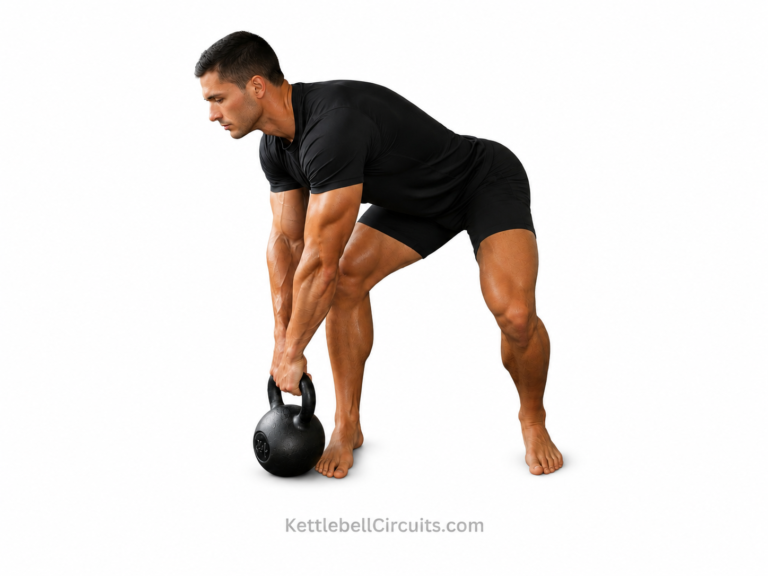
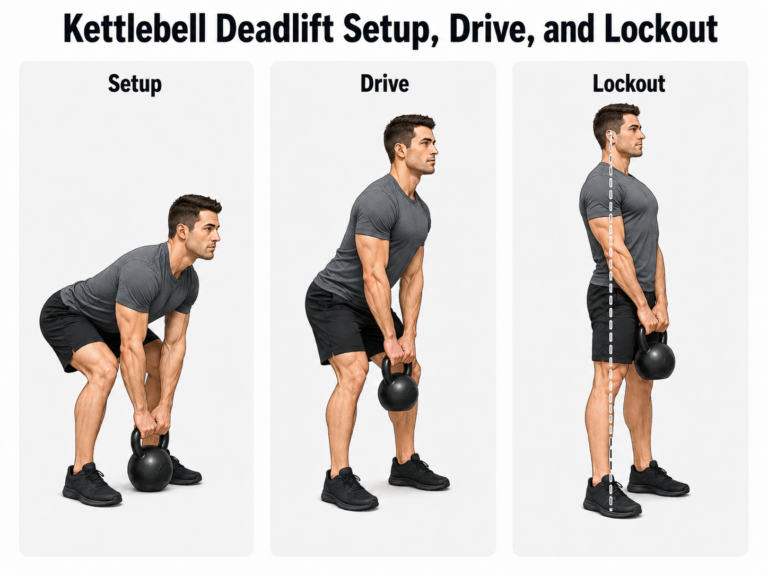
Kettlebell rotation exercises begin effectively with the rotational deadlift, a diagonal hinge that teaches the body to stabilize while generating controlled torque. This drill helps the hips set a powerful foundation for later, more dynamic rotational patterns. By lifting the kettlebell from an off-center position, the core must resist collapse, improving posture and strengthening spinal support. Practicing this movement slowly ensures safe form and maximizes learning.
The rotational deadlift also prepares the posterior chain for athletic lifting. It helps the hamstrings, glutes, and back coordinate as a unified system instead of working in isolation. Because the load is offset, balance improves and small stabilizers strengthen. This drill builds confidence and structural integrity for all future rotation work.
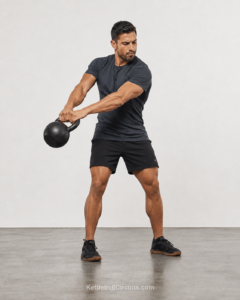
Generating diagonal power is a key purpose of kettlebell rotation exercises, making the rotational swing an essential training tool. This drill drives the kettlebell across the body while the hips rotate naturally, enhancing explosive strength. The movement teaches force transfer between the lower body and torso, an ability required in most sports and daily tasks. Practicing smooth transitions helps refine motor control and timing.
This swing variation enhances cardiovascular conditioning and muscular endurance. Because the trajectory travels across the body, the core must work harder to stabilize the spine. The movement also challenges grip and forearm muscles as the kettlebell changes direction. It is a powerful drill for developing rotational athleticism and overall efficiency in motion.
3. Rotational High Pull for Dynamic Upper-Body Power
Rotational high pulls expand the range of kettlebell rotation exercises by emphasizing upper-body involvement. The kettlebell travels diagonally from the hip to the opposite shoulder, teaching the torso to rotate under load. This helps bridge lower-body force into upper-body expression, producing a more complete power chain. The motion increases shoulder coordination and builds resilience in pulling patterns.
This drill is especially useful for athletes who require quick and forceful upper-body actions. The movement conditions the shoulders to stay aligned even during rapid directional changes. It also improves timing between the hips and arms, helping generate clean, powerful acceleration. When practiced consistently, the high pull enhances total-body rotational fluency.
4. Rotational Clean to Strengthen Transitional Control
Rotational cleans form an important link within kettlebell rotation exercises by teaching the body to control the kettlebell through rotational transitions. The bell travels along a diagonal path into the rack position, demanding stability from the torso. This drill enhances coordination between the hips, core, and shoulders while minimizing unnecessary strain. It is an effective way to practice rotational mechanics without losing control of the bell.
The rotational clean reinforces balance through asymmetric loading. By bringing the kettlebell to the rack from a rotated path, the lifter must stand tall without leaning. This encourages proper body alignment and stronger core activation. The skill also improves grip endurance and helps prepare for more advanced rotational lifts.
5. Rotational Press for Integrated Upper-Body Force
The rotational press advances kettlebell rotation exercises into upper-body strength territory by emphasizing diagonal pressing mechanics. The torso rotates slightly during the press, helping the shoulder move through a more natural path. This encourages healthy scapular movement and reduces unnecessary tension. The rotational press is an accessible drill for developing both strength and mobility.
This movement also helps the body coordinate force from the feet upward. As the torso rotates, the lower body must stabilize, strengthening the link between hips and shoulders. Improving this connection contributes to better posture in other lifts and daily tasks. The rotational press is a functional and versatile drill for full-body development.
6. Rotational Snatch to Build Vertical Speed
The rotational snatch expands the scope of kettlebell rotation exercises by uniting rotational drive with vertical acceleration. The kettlebell moves diagonally from the hip to a locked-out overhead position. This requires a powerful hip extension and coordinated torso rotation. The drill strengthens both speed and precision, making it highly effective for athletic development.
This movement also challenges shoulder stability at the top of the lift. Maintaining alignment during the lockout reinforces joint health and reduces unnecessary strain. Practicing the rotational snatch improves responsiveness in rapid movements. It is a high-value drill for athletes seeking explosive rotational power.
7. Around-the-World Rotation for Midline Coordination
Around-the-world patterns serve as a foundational element within kettlebell rotation exercises because they build midline coordination. Passing the kettlebell around the body teaches stability as the load shifts from side to side. The torso must resist over-rotation while still moving smoothly. This develops controlled mobility and enhances balance during transitions.
This drill reinforces awareness of weight distribution. The lifter feels how shifting forces influence posture and learns to compensate appropriately. Around-the-world patterns also prepare the shoulders and arms for more demanding rotational drills. The movement offers a simple way to refine coordination throughout the entire core.
8. Kettlebell Halo to Improve Thoracic Rotation
The halo contributes to the effectiveness of kettlebell rotation exercises by encouraging thoracic rotation and upper-body mobility. The kettlebell circles around the head while the ribs and shoulders rotate under control. This opens restricted areas of the upper back, helping reduce compensation in the neck and lower spine. The halo is particularly useful as a warm-up or mobility builder.
The drill also promotes shoulder health by moving the joints through a wide range of motion. Controlled rotation improves tissue resilience and reduces stiffness. The halo prepares the upper body for both pressing and pulling movements. Practicing this drill increases fluidity in overhead motions.
9. Kettlebell Woodchopper for Diagonal Force Production
Woodchoppers hold an important place in kettlebell rotation exercises for their ability to train diagonal force patterns. The movement mimics functional tasks like swinging tools or rotating quickly during sport. By generating torque from the hips and core, the woodchopper strengthens the entire kinetic chain. The diagonal trajectory adds variety and complexity to rotational training.
Practicing woodchoppers improves coordination between the upper and lower body. The drill teaches the lifter to stabilize the spine while moving powerfully through the torso. Because the load travels across the body, the core must resist excessive twisting. This movement enhances strength, endurance, and control in rotational action.
10. Standing Russian Twist for Torso Agility
Standing Russian twists elevate kettlebell rotation exercises by isolating upper-body rotation with planted feet. This drill teaches the torso to rotate independently of the hips, enhancing controlled spinal mobility. Holding the kettlebell at chest height engages the core and challenges the shoulders. The movement is simple yet effective for strengthening rotational endurance.
The standing variation avoids the lower-back strain common in seated twists. The body remains upright and aligned while rotation occurs in a controlled arc. This improves posture and breathing mechanics. The drill is ideal for both warm-ups and conditioning segments.
11. Tactical Lunge With Rotation for Functional Transitions
Tactical lunges enhance kettlebell rotation exercises by linking lower-body mobility with rotational control. Passing the kettlebell beneath the front leg requires coordination, balance, and precision. The torso rotates naturally as the kettlebell travels across the midline. This drill strengthens the hips, core, and shoulders simultaneously.
The tactical lunge improves movement quality in daily tasks that involve twisting under load. Because both legs participate, balance becomes more symmetrical. This improves gait and posture over time. The drill challenges multiple systems without requiring heavy weight.
12. Rotational Goblet Squat for Multi-Plane Strength
Rotational goblet squats add dimension to kettlebell rotation exercises by combining a standard squat with a torso twist. The lifter rotates at the top of the squat, training controlled movement under load. This improves rotational efficiency and teaches the body to remain stable in transitional phases. The drill enhances awareness of midline positioning.
This movement increases hip mobility and strengthens the core. It also improves the ability to maintain alignment during functional tasks that involve bending and turning. The rotational goblet squat is accessible for beginners and beneficial for advanced lifters seeking refinement.
13. Rotational Windmill for Lateral and Rotational Stability
Kettlebell rotation exercises progress meaningfully with the rotational windmill, a drill that teaches the body to hinge sideways while maintaining an overhead load. As the torso rotates and folds, the movement challenges the obliques, shoulders, and hips to work in harmony. The overhead arm stabilizes while the lower hand tracks toward the foot, creating a deeply integrated rotational pattern. Practicing this drill slowly enhances control and spatial awareness.
This movement is especially effective for strengthening the lateral chain of the body. It improves hip mobility, shoulder alignment, and ribcage flexibility while reducing asymmetries. Because it requires both stability and mobility, the rotational windmill is highly valuable for long-term joint health. Incorporating it regularly expands functional capabilities across multiple planes.
14. Rotational Step-Out Press for Diagonal Strength
Rotational step-out presses enhance kettlebell rotation exercises by encouraging coordinated diagonal motions between the lower and upper body. Stepping outward at an angle while pressing overhead teaches the hips and shoulders to cooperate smoothly. This diagonal force transfer strengthens the core and builds balanced power. Rotating slightly during the press promotes natural mechanics and reduces strain on the shoulders.
The movement helps the body stabilize while transitioning from one plane to another. This leads to better control in unpredictable environments and reduces the likelihood of awkward compensations. Practicing diagonal stepping patterns improves movement literacy and refines footwork. The rotational step-out press is excellent for athletes who depend on agility and directional changes.
15. Rotational Side Swing for Multi-Directional Conditioning
Rotational side swings contribute significantly to kettlebell rotation exercises by introducing a lateral element to swinging patterns. The kettlebell travels from side to side while the hips rotate subtly, creating a rhythm that builds endurance and coordination. This drill helps reinforce hip-driven movement, making rotational patterns smoother and more efficient. It also increases cardiovascular demand, offering a conditioning benefit.
The side swing improves tissue resilience across the torso and hips. Because the kettlebell changes direction frequently, the core must constantly adapt. This promotes quick stabilization and sharpens reaction time. The movement works well in both warm-up and conditioning phases, adding variety without complexity.
16. Split-Stance Rotational Row for Postural Strength
Split-stance rotational rows deepen the effectiveness of kettlebell rotation exercises by integrating pulling mechanics with diagonal torso rotation. Starting in a staggered stance, the lifter rows the kettlebell toward the hip while rotating the torso. This encourages a balanced distribution of load across the legs and core. Practicing this drill enhances postural integrity and pulling precision.
This movement develops strength along the back muscles responsible for stabilizing the spine. The staggered stance fosters balance, forcing the lifter to engage the lower body throughout the motion. It also improves grip and upper-back endurance. Rotational rowing is especially useful for athletes who rely on pulling power and rotational control.
17. Cross-Body Kettlebell Carry for Anti-Rotation Strength
Cross-body carries expand kettlebell rotation exercises by strengthening the torso’s ability to resist unwanted twisting. Carrying the kettlebell on one side while walking naturally introduces rotational forces. The core must stabilize to keep the torso upright, training anti-rotation endurance. This drill is simple yet highly effective for building foundational strength.
Loaded carries are known to improve posture and gait. The cross-body variation challenges the shoulders, hips, and obliques simultaneously. Maintaining alignment throughout the walk supports joint stability and coordination. Over time, this movement enhances daily functional performance and reduces back fatigue.
18. Rotational Racked March for Dynamic Balance
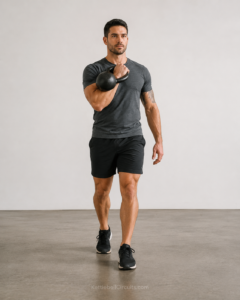
Racked marching patterns improve kettlebell rotation exercises by adding a dynamic balance challenge. Holding the kettlebell in the rack position introduces asymmetry, requiring the torso to resist rotation with each step. The marching motion engages the hips and reinforces alignment. This drill is excellent for training single-leg stability and midline control.
Marching under load sharpens proprioception and foot placement awareness. The movement strengthens the muscles that support gait and upright posture. Additionally, it enhances breathing mechanics by encouraging tall alignment. The rotational racked march is a practical way to refine balance while strengthening the core.
19. Rotational Clean-to-Press for Integrated Power
Clean-to-press sequences extend the variety of kettlebell rotation exercises by combining diagonal pulling and rotational pressing. The kettlebell moves from hip to rack and then overhead with a coordinated twist. This full-body sequence teaches the lifter to maintain control through multiple transitions. It is highly effective for generating power from the hips and expressing it through the upper body.
This drill develops rhythmic movement and enhances timing between segments of the body. It reinforces the concept of force transfer, which is vital for athletic performance. The clean-to-press also improves endurance and grip strength. Integrating this drill into training builds fluid and versatile athleticism.
20. Rotational Offset Swing for Stance Variation
Offset swings support kettlebell rotation exercises by challenging the body to generate power from an uneven stance. Standing slightly staggered shifts the center of gravity, requiring increased rotational stability. The kettlebell travels through a diagonal swing path that emphasizes hip rotation. This drill strengthens the lower back, glutes, and hamstrings in a dynamic way.
The asymmetry of this movement enhances core stability under shifting forces. It teaches the body to adapt quickly and maintain alignment regardless of stance. Offset swings add valuable variety and complexity to swinging patterns. Practicing them consistently improves resilience and coordination.
21. Hip Pivot Rotation Drill for Ground-Up Movement
Hip pivot drills highlight the lower-body mechanics within kettlebell rotation exercises by using foot pivots to create rotation. Turning the rear foot allows the hips to rotate naturally, reducing strain on the knees and spine. This drill combines footwork, hip mobility, and torso rotation. It prepares the body for explosive diagonal movements found in sport and martial arts.
Practicing hip pivots improves movement efficiency and reduces stiffness in the lower body. As the hips learn to rotate freely, the torso becomes more capable of generating torque. This drill enhances agility and makes rotational movements smoother. It is an excellent preparatory exercise for more advanced rotational training.
22. Rotational Overhead Lockout for Upper-Body Stability
Overhead lockouts benefit kettlebell rotation exercises by training the shoulders and ribcage to maintain stability while rotating. Holding the kettlebell overhead and rotating through the torso challenges alignment and control. This drill strengthens the midline and improves shoulder endurance. It promotes healthy mobility across the upper spine.
Maintaining overhead stability helps reinforce balanced posture. The drill enhances coordination and increases resilience in the shoulder girdle. Practicing rotational lockouts reduces compensation patterns and improves overhead performance. It is highly useful for strength athletes and general trainees alike.
23. Rotational Turkish Get-Up Variation for Multi-Stage Rotation
Rotational Turkish get-ups expand the sophistication of kettlebell rotation exercises by adding rotational elements to each transition. As the lifter moves from the floor to standing, the torso rotates to support alignment. This creates a multi-stage rotational pattern that challenges balance, strength, and coordination. It is one of the most complete rotational drills available.
This variation improves joint stability through a wide range of motion. It teaches the body to rotate safely during complex sequences. The drill enhances mobility in the hips, shoulders, and thoracic spine. Practicing this pattern develops exceptional full-body control.
24. Kettlebell Pivot Punch for Explosive Rotational Drive
The pivot punch completes the series of kettlebell rotation exercises by emphasizing explosive rotational expression. The lifter pivots the foot, rotates the hips, and “punches” the kettlebell forward in a pressing motion. This drills the same mechanics used in striking sports and rotary power events. It unifies torso rotation with upper-body force production.
This drill enhances speed and coordination while teaching efficient energy transfer. Practicing pivot punches strengthens the diagonal lines of the body responsible for powerful rotation. It is an excellent conditioning tool for athletes seeking quickness, precision, and rotational fluency.