The foundation of rotational training is learning to resist it — these five kettlebell drills build the trunk stiffness that makes rotational movement safer and more effective.
A kettlebell dragged across the floor in a plank wants to rotate the hips. A kettlebell row from a plank wants to open the torso. A kettlebell swung with one arm wants to pull the body toward the loaded side. In each case, the training goal is the same: stay square. Do not let the load rotate what it is trying to rotate.
That is anti-rotation — and most kettlebell programs treat it as an afterthought. Carries, holds, planks, swings, and asymmetric loading patterns, if they appear at all, often sit at the end of a session as filler. They rarely get their own programming, their own progression logic, or a clear explanation of why they belong in a training plan permanently rather than as a beginner phase to pass through.
Anti-rotation kettlebell exercises build the trunk stiffness that makes rotational movement safer and more effective. Without the core’s ability to resist unwanted twist under load, explosive work may become riskier, adding speed to a system that cannot control it. The five drills below develop that control. Each one creates a rotational force on the trunk, and the lifter’s job is to prevent that force from winning.
Readers with a history of spinal injury, disc herniation, or chronic low back pain should consult a qualified professional before beginning anti-rotation training.
The Bell Moves, the Trunk Doesn’t
Not every exercise in this list looks like a stability drill. The single-arm swing is ballistic. The Turkish get-up moves through multiple planes. The around-the-world sends the bell on a continuous loop around the body. These are not all static holds — but they all require the core to manage unwanted movement under asymmetrical load.
The defining feature is not whether the body moves, but what the trunk is doing while it moves. In every exercise below, the kettlebell or the movement pattern creates a force that tries to rotate, tilt, or twist the trunk. The training goal is to resist that force. The limbs move. The load shifts. The trunk stays controlled.
This distinction matters because readers who see a swing or a get-up categorized as anti-rotation may assume the label is wrong. It is not. The swing is explosive, but the training effect of the single-arm version includes the trunk’s ability to resist the rotational pull the asymmetry creates. The get-up involves transitions through multiple positions, but at every stage the overhead load challenges the lifter to keep the shoulder, ribcage, and pelvis organized.
“Stay square” is the governing cue. If the trunk twists, tilts, shifts, or collapses under the load, the anti-rotation benefit is lost — regardless of how the rest of the movement looks.
Who Benefits From Anti-Rotation Work
Anti-rotation kettlebell exercises are not reserved for beginners or rehabilitation. They serve four populations, and most readers fall into at least one.
Beginners building core stability for the first time benefit because anti-rotation drills teach the trunk to brace under asymmetric load before adding the complexity of producing rotation. The renegade row and plank drag are entry points that develop foundational stiffness without demanding advanced rotational coordination.
Anyone returning to training after injury — after appropriate clearance from a qualified professional — benefits because anti-rotation exercises can load the trunk without requiring aggressive spinal rotation. The core works hard while the spine stays controlled.
Athletes who need trunk stiffness under bilateral loads — squats, deadlifts, cleans — benefit because anti-rotation strength may contribute to fewer force leaks and compensations under heavy sagittal-plane lifts. A trunk that cannot resist rotation under a single-arm swing or plank drag will struggle when heavier, faster, or more complex loading tries to pull it out of position.
Anyone adding rotational training to their program for the first time benefits because anti-rotation is the first category in the progression. The stability base comes before controlled rotation, and controlled rotation comes before explosive rotation. Skipping anti-rotation to get to rotational swings is skipping the foundation to get to the finish.
The 5 Drills
1. Kettlebell Renegade Row
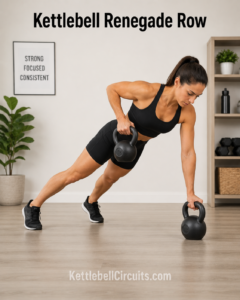
Start in a high plank position with both hands on kettlebell handles, feet slightly wider than hip width for stability. Row one bell to the ribcage while the other arm stays locked out on the floor. Return the bell to the floor and repeat on the other side.
Cue: The hips and shoulders stay square to the floor throughout the row. No opening, no rotating, no shifting. The row is an arm movement — the trunk does not participate.
Common error: The hips rotate toward the rowing arm, or the torso twists to help pull the bell. If either happens, the weight is too heavy or the plank position has collapsed. Widen the feet for more stability, or reduce the bell weight until the trunk stays square for every rep.
What it trains: Anti-rotation and anti-extension in a horizontal position. The row creates a unilateral pull that tries to twist the torso toward the working arm while the plank demands anti-extension. Resisting both simultaneously trains the deep stabilizers in a way that bilateral rows or standard planks do not.
2. Kettlebell Plank Drag
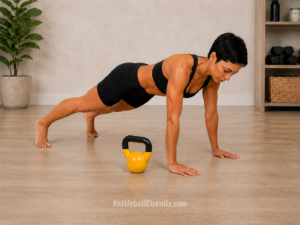
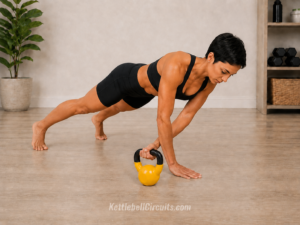
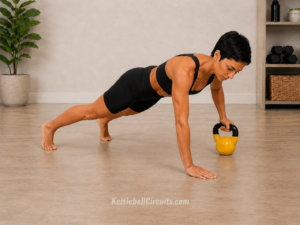
Start in a high plank position with a kettlebell on the floor just outside one hand. Reach under the body with the opposite hand, grab the bell, and drag it across to the other side. Re-set the plank, then drag it back with the other hand.
Cue: The hips stay square and level throughout the drag. The reaching arm moves the bell — the trunk does not rotate to assist. If the hips rise or twist during the reach, slow down or widen the feet.
Common error: Allowing the hips to rotate or pike upward during the drag. The moment the hips twist, the exercise stops being anti-rotation and becomes a compensated reach. Keep the drag slow and the plank locked.
What it trains: Anti-rotation in a horizontal position with a dynamic upper-body component. While one arm reaches and pulls, the core must prevent the torso from rotating toward the working side. The drag adds a shifting load that changes the rotational demand with each rep — the bell pulls from a different angle as it moves across the floor.
3. Turkish Get-Up
🖼️ IMAGE PLACEHOLDER: Turkish Get-Up
The Turkish get-up moves from the floor to standing and back through a series of transitions: roll to elbow, elbow to hand, hand to half-kneeling, half-kneeling to standing, then back down under control. The movement is not a pure anti-rotation drill, but the overhead kettlebell creates a continuous demand for trunk control, shoulder stability, and clean alignment.
Cue: The overhead arm stays locked at every stage. The bell stays stacked over the shoulder. Move slowly enough to keep the shoulder, ribcage, and pelvis organized through every transition.
Common error: Letting the bell drift, the ribs flare, or the torso collapse during the transition from the floor to the elbow, the leg sweep, or the move from half-kneeling to standing. If the load pulls the body out of position, the weight is too heavy or the transition is being rushed.
What it trains: Trunk control under a shifting overhead load through multiple planes and positions. The Turkish get-up challenges the core to resist unwanted twisting, leaning, and collapsing while the body changes levels. It belongs to practitioners who can maintain control through every position under load.
4. Single-Arm Kettlebell Swing
🖼️ IMAGE PLACEHOLDER: Single-Arm Kettlebell Swing
Perform a standard kettlebell swing with one hand. The bell travels through the same hinge-driven swing path as a two-hand swing, but the single-arm load increases the rotational pull on the trunk.
Cue: Keep the torso square and the swing path clean despite the uneven loading. The feet stay planted. The shoulders stay level. The bell travels through the centerline without pulling the body into rotation.
Common error: Allowing the trunk to twist toward the working arm at the top of the swing or during the backswing. If the shoulders rotate, the hips shift, or the bell drifts off line, reduce the weight and rebuild the hinge.
What it trains: Anti-rotation expressed through a ballistic hinge. The swing is explosive — the hip snap, the float, and the descent are all high-speed — but the trunk must stay organized while the hips produce force. This is where anti-rotation meets power: the core resists the rotational pull created by the single-arm load.
5. Kettlebell Around-the-World
🖼️ IMAGE PLACEHOLDER: Kettlebell Around-the-World
Stand upright and pass the kettlebell around the body at waist height, transferring it from hand to hand behind the back and in front. The bell circles the body in a continuous loop.
Cue: The pelvis stays square. It does not chase the bell. The arms move the bell around the body — the trunk does not rotate to help. If the hips start following the bell, slow down or lighten the weight.
Common error: Rotating the hips with the bell instead of resisting the shifting load. This turns the exercise from anti-rotation into a momentum drill with no clear training target. The value of the around-the-world is in what the trunk does not do — it does not rotate — while the bell moves around it.
What it trains: Anti-rotation endurance and grip coordination through a continuous, looping path. The shifting load creates a constantly changing rotational demand on the trunk — sometimes pulling left, sometimes right, sometimes forward, sometimes back. The core must adjust to each shift without giving in to any of them.
Programming Anti-Rotation in a Training Session
Anti-rotation exercises fit well in the warm-up and activation portion of a session. A set of plank drags, renegade rows, or around-the-worlds at the start can wake up the trunk stabilizers and prepare the core for heavier work without generating excessive fatigue.
Pairing an anti-rotation exercise with a rotation exercise in a superset is a practical structure. A set of plank drags followed by controlled rotational work trains stability before motion. A set of single-arm swings followed by a slower rotational drill trains power and control in the same block. The anti-rotation exercise sets the foundation; the rotation exercise builds on it.
Load selection follows the governing cue: if the trunk cannot stay controlled, the weight is too heavy. This is not a category where grinding through heavy reps with compensated form produces a useful training effect. The effect is the absence of compensation — and that requires a load the core can actually control.
Volume guidelines: 2–4 sets of 8–12 reps per exercise, or 30–40 second rounds for continuous drills like the around-the-world. Two to three sessions per week with anti-rotation work is sufficient for most people. These exercises do not require a dedicated session — they integrate into existing training.
When to Progress to Controlled Rotation
Anti-rotation proficiency looks like this: the renegade row and plank drag can be performed without the hips twisting or shifting. The Turkish get-up can be performed with control at every transition. The single-arm swing stays clean — the trunk does not chase the loaded side. The around-the-world can be performed without the pelvis following the bell.
When these benchmarks are met, the reader is ready to add controlled rotation — exercises where the body deliberately produces rotation through a defined range. This does not mean stopping anti-rotation work. It means adding controlled rotation alongside it. Anti-rotation stays in the program permanently. The rows, drags, swings, get-ups, and around-the-worlds that built the foundation continue to maintain it.
The next step in the progression is Controlled Rotation Kettlebell Exercises — 7 Drills That Build the Turn.