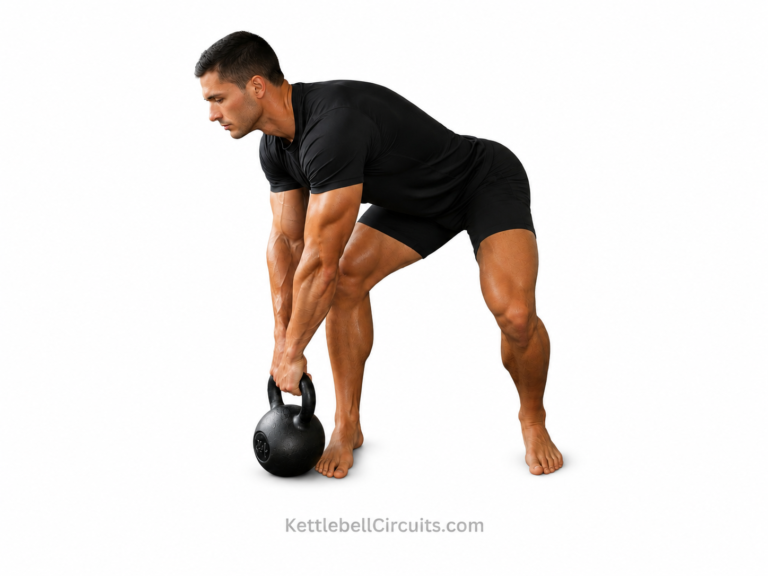
How the kettlebell deadlift teaches the hip hinge under load and why many kettlebell ballistics build from the same pattern.
Many people pick up a kettlebell and go straight to swings. It makes sense — the swing is the exercise kettlebell training is known for, and it looks like the obvious place to start. But the swing is a ballistic movement. It expresses the hip hinge at speed, under momentum, with a float phase at the top and a fast deceleration at the bottom. If the hinge pattern underneath the swing is not solid, there is no slow-motion version happening inside the fast one. The body may compensate — the lower back may round or overextend, the hamstrings may not fully load, and the glutes may fire late instead of driving the movement.
That compensation does not stay contained. Cleans and snatches often inherit the same faults because both movements use swing-like hip drive built on the same hinge pattern. The clean uses that hip drive and redirects into a rack position. The snatch uses it and redirects overhead. If the hinge is off, the downstream lifts carry its problems plus their own.
The kettlebell deadlift exists to solve this in the right order. It teaches the hip hinge as a slow, controlled grind — the same pattern the swing will later express at speed, but with enough time to feel every position: where the weight sits in the feet, when the hamstrings load, how the lats hold the bell close, what full hip extension actually feels like. Master the deadlift first, and the swing has a foundation to build from.
A Centered Load Changes What the Hinge Teaches
A kettlebell deadlift is not a barbell deadlift performed with a lighter implement. The two exercises share a hip hinge pattern, but the tool changes what the movement teaches.
In a conventional barbell deadlift, the bar sits in front of the shins. The lifter grips it outside the legs with a pronated or mixed grip and must manage a bar path in front of the legs while keeping the bar close and balanced over the midfoot. This demands precise path management and shin clearance throughout the pull.
The kettlebell changes the geometry. The bell can be positioned between the feet or slightly ahead of them, which allows many beginners to keep the load closer to their center of mass and find a manageable hinge position more easily. The handle sits higher off the ground than a barbell’s plates, and the neutral grip lets the hands fall naturally without fighting the shins for space.
In one important respect — the centered load — the kettlebell deadlift is more similar to a trap bar deadlift than a conventional barbell pull. The comparison has limits: a trap bar allows much heavier loading and positions handles at the sides rather than between the feet. But the centered load position is the shared feature that matters for learning. It lets the lifter practice the hinge without the barbell’s stricter path and clearance demands, which makes it a useful entry point before progressing to the swing’s arc or to heavier barbell work.
How the Hinge Loads the Posterior Chain
The muscles involved in the kettlebell deadlift are the same ones responsible for the hip hinge pattern across all its expressions — deadlift, swing, clean, snatch. Understanding how they share the work explains why the deadlift builds the foundation the other lifts depend on.
The glutes and hamstrings are the primary movers. They produce hip extension — the force that stands the body up and drives the bell off the floor. The spinal erectors mainly work to maintain trunk position rather than to deliberately pull the bell up; their job is resisting spinal flexion, not creating extension. The lats help keep the bell close and the shoulders connected to the trunk, preventing the arms from drifting forward and pulling the torso out of position. The core — particularly the anterior core — works as an anti-flexion brace, transmitting force between the lower and upper body without allowing the spine to buckle.
(Image 2 — Posterior Chain Muscle Roles in the Hinge)
This is not a casual list of muscles. The pattern of activation matters. In a 2013 study published in the British Journal of Sports Medicine, Zebis et al. measured hamstring EMG during 14 therapeutic exercises in elite female athletes. The hip hinge movements — kettlebell swing and Romanian deadlift — produced very high hamstring activation, specifically targeting the semitendinosus (the medial hamstring) at 73–115% of maximal voluntary contraction. The study tested swings and Romanian deadlifts rather than the conventional kettlebell deadlift, and the population was elite female handball and soccer players, so the findings do not directly generalize to all trainees. But they do show that the hinge pattern itself — the movement the deadlift teaches — produces meaningful posterior chain recruitment. The deadlift and the swing share the same muscular engine.
Kettlebell Deadlift Form: Setup, Drive, and Descent
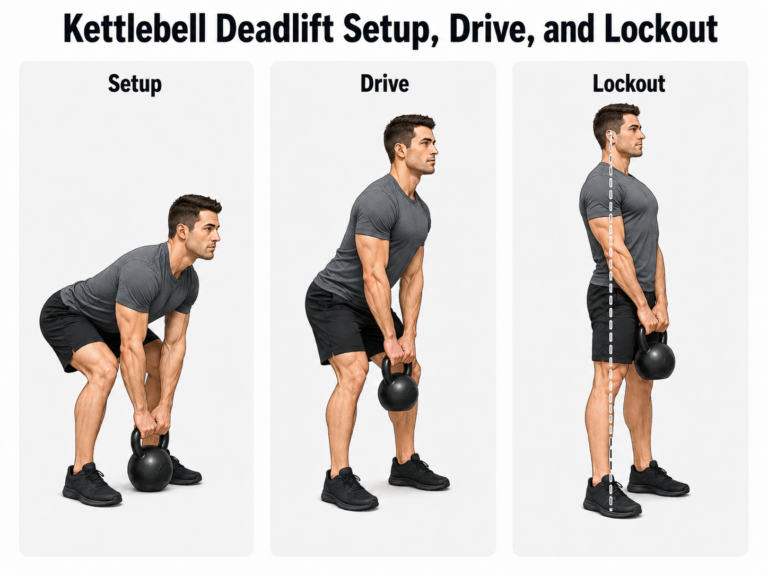
Setup. Stand with feet roughly hip-width apart. Place the kettlebell on the floor between your feet, handle running left to right. Push your hips back and bend your knees enough to reach the handle without rounding your back. Grip the handle with both hands. Before you lift, set two things: set your lats by pulling your shoulders away from your ears and keeping your armpits tight (the cue “squeeze an orange in your armpit” works well), and brace your core as if someone were about to push you.
The drive. Push the floor away with your feet. Do not think about pulling the bell up — think about standing up by driving your hips forward. Your arms stay straight; they are hooks holding the bell, not engines lifting it. The hips and knees extend together. At the top, stand tall with your hips fully extended and your glutes squeezed. Do not lean back past vertical.
The descent. Push your hips back first, not your knees forward. The bell travels back down the same path it came up. Control the descent — do not drop into the bottom position. Set the bell down, reset your brace, and repeat.
Cues that work. “Close a car door with your hips” teaches the hip snap at lockout. “Split the floor with your feet” activates the glutes and creates external rotation torque at the hips. “Squeeze an orange in your armpit” sets the lats and protects the shoulders.
Common errors and their causes. Rounding the back is often caused by loading beyond the lifter’s current ability, insufficient bracing, or a setup that starts too far from the bell — limited posterior chain flexibility can also contribute, and the fix is a lighter bell, an elevated starting position, or focused hamstring and hip mobility work. Squatting the weight up instead of hinging it means the knees are leading the movement rather than the hips; a wall drill (standing a foot from a wall and pushing your hips back to touch it) repatterns this quickly. Jerking the bell off the floor means there was no tension in the system before the pull; the fix is pulling the slack out of the body before driving. Hyperextending at the top — leaning back past vertical — is often a lumbar extension habit or an attempt to “finish” the rep visually rather than through hip drive; the fix is squeezing the glutes at lockout and stopping when the hips are level with the shoulders.
From Deadlift to Swing: Why the Slow Version Comes First
This is the section that matters most for anyone training with kettlebells, and it is the reason the kettlebell deadlift is not just a beginner exercise to outgrow.
In kettlebell training, exercises are divided into grinds and ballistics. A grind is slow, high-tension, and controlled — the deadlift, the press, the squat. A ballistic is fast, explosive, and rhythmic — the swing, the clean, the snatch. Both grinds and ballistics use the hip hinge, but they express it differently. The deadlift teaches the hinge as a position: where the weight sits, how the hamstrings load, when the hips fire. The swing takes that same position and adds speed, timing, a float phase, deceleration, and elastic loading. The deadlift is the pattern; the swing is the pattern at velocity.
If the hinge is not grooved under the slow conditions of the deadlift, the body may struggle to find it under the fast conditions of the swing. Speed hides bad positions. A slightly rounded lower back that a coach would catch in a deadlift becomes invisible at swing speed — invisible to the eye, but not to the spine.
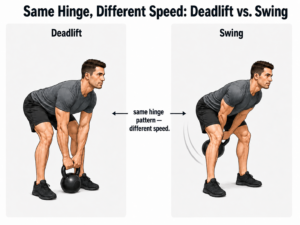
This is a widely used coaching progression, not a proven universal motor-learning law. But it is how many kettlebell programs and certifications structure their teaching. CrossFit’s official kettlebell snatch warm-up lists the progression explicitly: Step 1 kettlebell deadlifts, Step 2 kettlebell swings, Step 3 kettlebell clean and press, Step 4 kettlebell snatch. Each step adds one variable to the hinge: the deadlift adds load, the dead-stop swing adds momentum, the continuous swing adds rhythm, and the clean and snatch add redirection.
The deadlift also connects to the clean and snatch downstream. The clean is a swing that redirects into a rack position at the chest. The snatch is a swing that redirects overhead into lockout. The hinge is the common root — though cleans and snatches also depend on trajectory, grip timing, rack mechanics, and shoulder control that the deadlift does not teach. The deadlift builds the foundation; it does not build the whole house.
Six Variations and What Each One Trains
The conventional two-hand kettlebell deadlift is the starting point. These six variations each change one variable to shift the training emphasis.
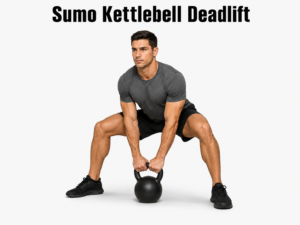
Sumo kettlebell deadlift. A wider stance with toes turned out shifts more work to the adductors (inner thighs) and allows a more upright torso. This variation suits lifters with lower back sensitivity, longer femurs, or anyone who finds the conventional stance uncomfortable. The wider base also allows a shorter range of motion.
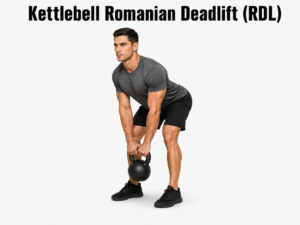
Kettlebell Romanian deadlift (RDL). Starts from standing rather than from the floor, and the bell does not touch the ground between reps. This keeps constant tension on the hamstrings through the entire set and emphasizes the eccentric (lowering) phase. The RDL builds hamstring strength and eccentric control that transfers directly to the backswing phase of the kettlebell swing.
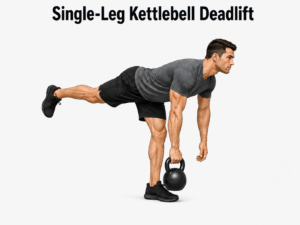
Single-leg kettlebell deadlift. Performed on one leg with the other leg extending behind for counterbalance. This variation builds unilateral strength and balance, identifies and corrects side-to-side imbalances, and challenges single-leg stability through the hip and knee. It is significantly harder than it looks, even with lightweight.
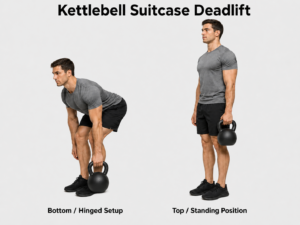
Suitcase kettlebell deadlift. The bell sits beside one foot rather than between the feet, gripped with one hand in a neutral position. This trains anti-rotation — the obliques and lateral core must prevent the torso from tilting toward the loaded side. It mimics real-world one-sided carrying and builds the kind of core stability that bilateral deadlifts do not challenge.
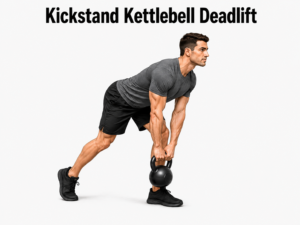
Kickstand kettlebell deadlift. One foot is flat on the ground, carrying the load; the other foot is positioned behind on the toes, acting as a stabilizer. This is an intermediate step between the bilateral deadlift and the full single-leg version. It lets the lifter load one leg more heavily while keeping a balance point that makes the movement accessible.
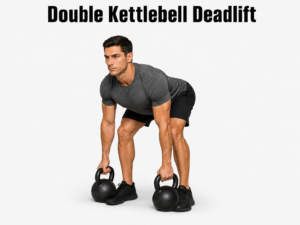
Double kettlebell deadlift. Two bells, one outside each foot, gripped with both hands. This increases total load and trains bilateral grip strength. The mechanics are the closest of any kettlebell variation to a barbell deadlift, and the doubled load makes it a genuine strength-building exercise for lifters without access to a barbell.
When the Kettlebell Deadlift Stops Being the Right Tool
The kettlebell deadlift does four things well: it teaches the hinge to beginners, it builds the foundation for the swing progression, it develops the posterior chain at moderate loads, and it works in a home gym where space and equipment are limited.
It stops being the right primary tool in four situations. First, when absolute strength is the goal and the available kettlebells cannot provide enough load — at that point, a barbell deadlift or trap bar deadlift delivers progressive overload more efficiently. Second, when the lifter has already grooved the hinge pattern and needs heavier loading to keep progressing — the kettlebell deadlift becomes a warm-up or accessory rather than the main lift. Third, when the lifter cannot reach the bell without rounding the spine, even with coaching — in which case the fix is elevating the bell on a box or step to shorten the range of motion, then progressively lowering it as flexibility improves. Fourth, when the available kettlebells are too light to drive any training adaptation at all.
Once KB loading is outgrown for strength purposes, the kettlebell swing typically becomes the primary kettlebell hip-hinge exercise, because the ballistic loading of the swing produces training stress beyond what the bell’s static weight suggests.
Programming the Kettlebell Deadlift in a Training Session
Where the deadlift fits in a session depends on what it is being used for.
As a warm-up and pattern primer, 2–3 sets of 5 reps with a light to moderate bell before swings or cleans. The purpose is to groove the hinge and activate the posterior chain, not to fatigue it. This is how the deadlift most commonly appears in an experienced kettlebell trainee’s session — a few crisp sets to set the pattern before the ballistic work begins.
As the main strength movement, 3–5 sets of 5–8 reps with a heavy bell. This is appropriate when building baseline posterior chain strength before introducing ballistics, or when the double kettlebell deadlift is the heaviest hip hinge available. Rest fully between sets — 2 to 3 minutes — to maintain tension quality.
As part of a circuit, paired with a press and a goblet squat for a full-body session: deadlift, press, squat, rest, repeat. This is a simple and effective structure for general kettlebell training.
A note on fatigue. Beginners should avoid high-rep deadlift sets or fatigued deadlifts in circuits until they can maintain spine position and hinge mechanics consistently under load. The deadlift teaches positions. If fatigue degrades the position, the exercise is no longer teaching the right pattern — it is reinforcing a compromised one.
Weight selection. Start with a bell you can deadlift for 10 controlled reps with perfect form. Progress to a heavier bell when you can complete 5 sets of 5 with full tension and no form breakdown. These are starting ranges, not fixed prescriptions — adjust based on the lifter’s training history and the role the deadlift plays in the session.
Who Should Get Clearance Before Loading the Hinge
The kettlebell deadlift is a low-risk exercise when performed with correct form and appropriate load. But certain conditions warrant clearance from a qualified professional before loading the hinge pattern under any weight.
Acute or radiating back pain — especially with numbness or tingling into the legs — should be evaluated before any loaded hip hinge work. Recent hip, spine, or abdominal surgery requires clearance based on healing timelines and surgical restrictions. Known osteoporosis or elevated fracture risk may require load modifications or alternative exercises. Late pregnancy or postpartum uncertainty about abdominal wall recovery should be assessed by a pelvic floor physiotherapist or qualified prenatal and postnatal exercise specialist before loading. And if a lifter cannot hinge without spinal rounding even with the bell elevated on a box, the range of motion is not yet available for this exercise — mobility work comes first.
This section does not diagnose. It names conditions where someone other than the lifter — a sports medicine physician, a pelvic floor physiotherapist, or a qualified coach — should make the training decision.
Quick Reference: Kettlebell Deadlift
Setup: Feet hip-width, bell between feet, hips back, grip the handle, lats engaged, core braced.
Drive: Push the floor away. Hips and knees extend together. Arms stay straight. Stand tall, glutes squeezed at lockout.
Descent: Hips back first, controlled return, bell to the floor, reset tension before the next rep.
Key cues: “Close a car door with your hips.” “Squeeze an orange in your armpit.” “Split the floor with your feet.”
Common fixes: Rounding → lighter bell or elevated start. Squatting → wall drill. Jerking → pull slack out before driving. Hyperextending → squeeze glutes, stop at vertical.
Progression: Bodyweight hinge → kettlebell deadlift → dead-stop swing → continuous swing.
Programming: Warm-up: 2–3 × 5 light. Strength: 3–5 × 5–8 heavy. Circuit: pair with press and squat.
One issue caught during display: the image numbering is out of reading order. The form sequence image appears after the posterior chain image in the article, but is labeled Image 1 while the posterior chain is labeled Image 2. In reading order, the posterior chain image comes first. Either renumber so posterior chain is Image 1 and form sequence is Image 2, or accept the current numbering as reflecting priority rather than reading order. Your call.